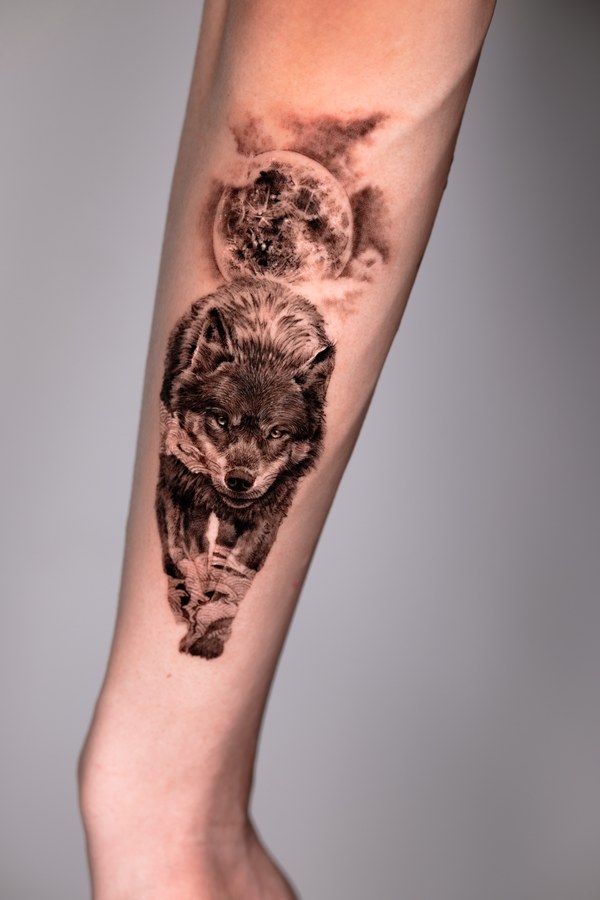
Will it really look like my animal? It is the question I get most about this subject, and the one that most needs an honest answer. Here it is: a large part of the likeness is already decided by the photograph you bring.
Portrait work is not inventing what is not there; it is carrying the information in a photograph across onto skin. If the catchlight in the eye is not in the photograph it will not be in the design, and if the direction of the fur around the nose is smeared, that part has to be filled in by guesswork. The more guesswork, the closer it gets to 'a dog that looks like yours'; the more information, the closer to your dog.
Four things that make a photograph usable
Eye level. Shot from standing height, looking down, the nose comes out large and the forehead narrow. That is a distortion of how the animal actually looks, and carrying it over straight looks wrong. Best is a photograph taken with the camera down at their eye level, lying or sitting on the floor.
Light. Daylight by a window, or outdoors in shade, beats an indoor bulb. Direct sun throws shadows so hard that the fur information is wiped out, and a dark room forces the camera to lift the brightness, which brings noise and smears the texture of the coat. Soft light coming in from one side of the face is ideal — the shading that light makes is what becomes the depth in the design.
Focus and resolution. The eyes have to be in focus. If you zoom in on the face on your screen and can tell the eyebrow hairs and whiskers apart one by one, that is enough. A photograph that has been through a messaging app or social media and downloaded again has usually lost quality once already, so send the original camera file where you can.
Expression. Their usual face is the one to use. An ear that sits half folded, a habit of lifting one side of the mouth — those are what make them themselves. If it is hard to settle on one front-on shot, send several. I pick one to set the basic composition and use the rest to check the shape of the eyes and ears.
Photographs that make it hard
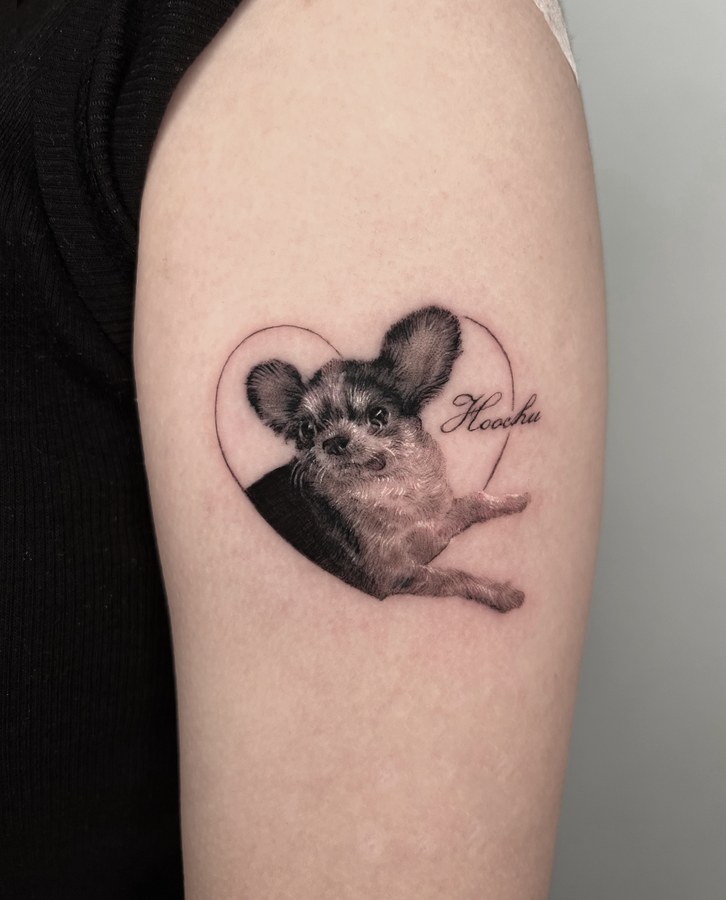
A dark-coated animal photographed in a dark room is the hardest of all: the whole face comes out as one mass, with no edges between eyes, nose and muzzle anywhere in the picture. In that case I will ask you to take another by a window.
Also difficult: shot from far off so the face is small; part of the face behind a hand or a lead; and a photograph whose proportions have been altered by a retouching app. That last one people often do not know about — automatic enhancement enlarges the eyes or cleans away the grain of the fur, and the information I need has gone with it. (Put it beside the original and the difference is plain.)
Often the animal has already gone and only a few photographs are left. Then we find the best direction within what there is. A less than perfect photograph does not mean the work cannot be done — it means I tell you honestly, in advance, how far it can go.
Size and placement for a pet portrait
A portrait is the hardest subject to shrink. The distances between eyes, nose and mouth are fixed; make the whole thing smaller and those distances close up with it, and as the ink spreads a little over the years the features run into each other. The likeness is the first thing to go.
So rather than a narrow spot such as the wrist or the ankle, I suggest a surface with vertical room: the inner or outer forearm, the shoulder, the thigh, the calf. Over a joint or on the back of the hand, where there is constant movement and friction, a face loses its shape quickly, which works against a portrait. There is more on how much it hurts by placement on the FAQ page.
Black and grey or fine line: different purposes
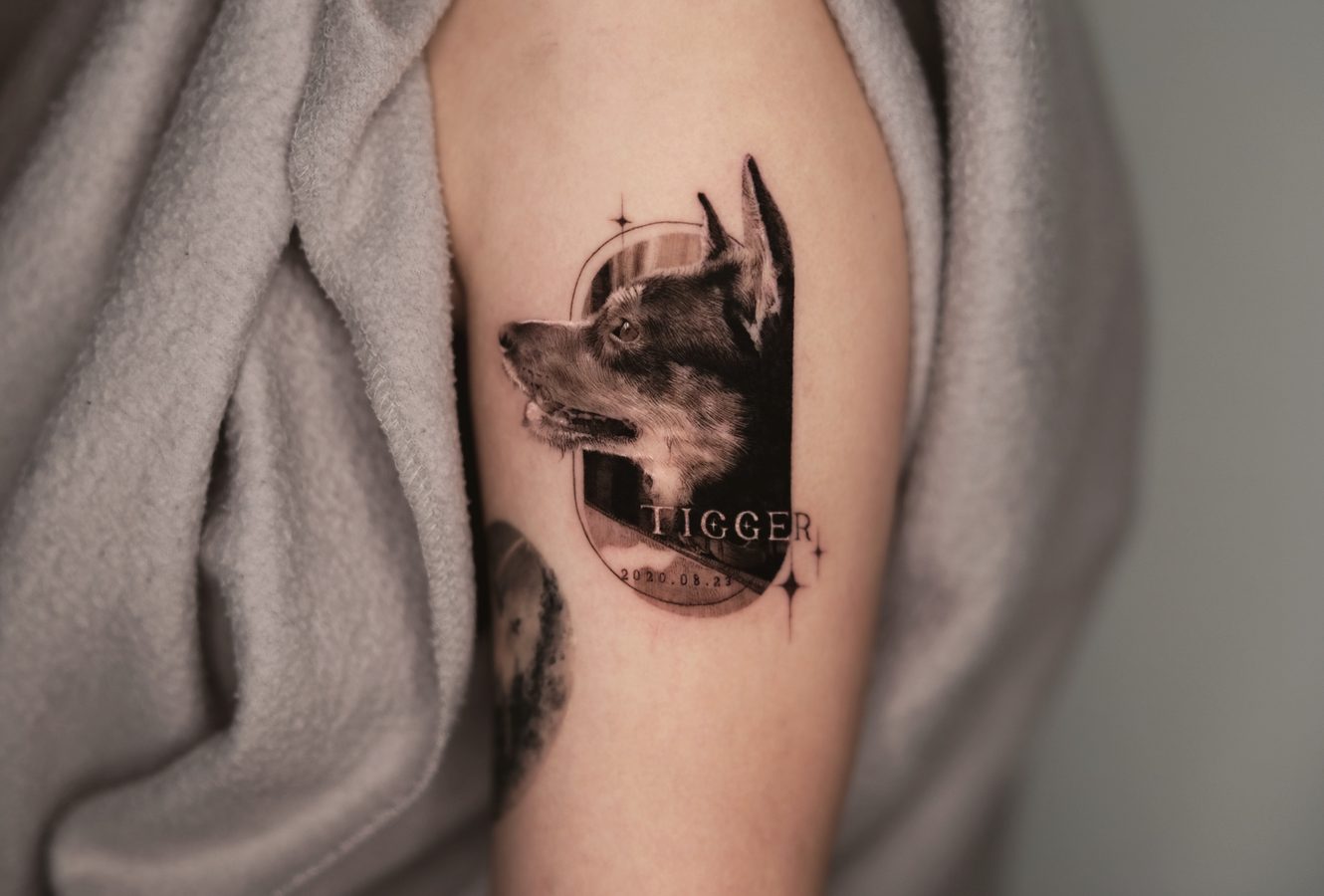
Black and grey shading gets closest to the photograph. The length and direction of the fur and the catchlight in the eye can all come across, so if likeness is the goal, this is the way. It needs area, though, and the session is long.
A fine-line portrait keeps only the lines that characterise the face: the angle of the ears, the outline of the muzzle, the line of the eyes. It will not look like the photograph, but it is far lighter, it can go small, and because the form stays simple it holds up over the years. It also sits well with a paw print or a name alongside.
It is less that one is better than that they are for different things: do you want to keep the face, or keep the presence? I always ask this at the consultation. Once size and method are settled I give you the range there and then; what sets the price is on the FAQ page.
One more thing, if it is a memorial
A good number of people come to keep an animal they have lost. Settling the design can itself be hard going, because it means looking at the photographs for a long time and revising the draft again and again.
So I tell people not to hurry. Take the draft away, live with it for a few days, then decide. I will move the appointment to suit. Better to take the time and end up with a design you are happy with than to settle it quickly and be left wishing otherwise.
Frequently asked
Q. How many photographs should I send? One to work from is enough to start, but three or four more that show the eyes and the shape of the ears make the design far more accurate. A mix of angles is ideal.
Q. Can I have two animals together? Yes. But two faces side by side halves the area available to each, so the whole piece has to be larger than it would be for one if the likeness is to hold. Whether they sit side by side or one above the other also changes which placements work.
Q. Can I add a name or a date later? Yes. If space for lettering is left when the design is first laid out, adding it later will not look bolted on. Additional work waits until the existing tattoo has healed properly; how the healing goes is set out on the home page. Healing speed varies a lot from person to person, so we set the date by looking at the skin. If anything looks wrong, see a doctor first.
Bookings and enquiries →