"What did you have in mind?" People who answer that with a whale usually do not explain at length. I just like them, more often than not, and that is the end of it. Talk a little longer, though, and something similar tends to be underneath: they have come through something that took a long time, or they are still coming through it. Which is why the explanation is short.
In one sentence, a whale tattoo is a mark of something that travels far and remembers long. Whales cross thousands of kilometres, hold their relationships together by sound, and spend long stretches swimming alone. Those three facts became the symbol as they stand: the journey, the bond and the memory, and the strength of being alone.
Which whale it is changes what it says
The impression shifts with the species. The big streamlined ones — blue and right whales — carry weight and slow time. An orca, with its pronounced dorsal fin, reads as pod, hunt and solidarity. Square-headed species such as the sperm whale carry the flavour of old voyage records, which gives the piece a narrative air.
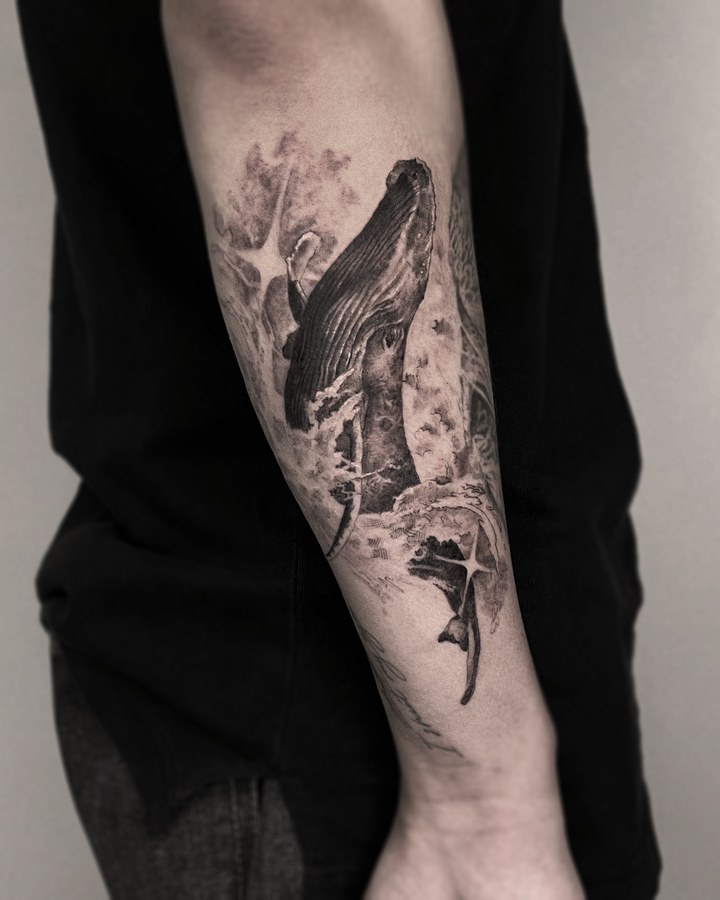
Certain elements are often set alongside it. Wrap it in waves or water lines and the journey comes forward; put a star or a moon above it and it leans towards longing or a dream; place a paper boat or a small human figure beside it and the contrast in scale brings out the relationship between a person and the world. At the consultation, settling that combination alone settles half the design.
Some people have a whale as a memorial, for that quality of remembering long. In those cases I tend to take the design quieter — fewer waves, the silhouette alone.
A whale is one of the few subjects a silhouette finishes
Technically a whale goes very well in black and grey, and there is a reason. It is one of the very few forms you recognise instantly from the outline alone.
A rose needs its petals drawn to be a rose; a butterfly needs its symmetry to be a butterfly. A whale is different. A full body, a split tail, one pectoral fin — with those three it reads as a whale even with the inside left completely empty. Which is to say it is a drawing that does not lean on detail, and that in turn means the form survives the years.
That makes it especially good small. A mini whale about three centimetres across does not collapse. At the same size a flower or a face becomes hard to read within a few years. It is one of the reasons I recommend a whale for a first tattoo.
Drawn in line, or filled as a mass
The same whale goes two ways.
A fine-line whale keeps the outline and leaves the inside empty. It is light and plain, and it feels less laid on the body than passing across it. The common mistake here is packing the inside with scenery — waves, stars, mountains. Gather several thin lines inside a narrow shape and over the years they spread into each other, and what is left is one grey mass. There is more on how thin lines spread over time on the fine line page. If you do want something inside, keep it to two or three elements with generous gaps.
A black-and-grey whale does the opposite and fills. Press the back dark and lift it lighter towards the belly and you get the impression of light coming down through water. A whale's body is close to a cylinder, so if that gradient is right the volume reads even without a single fin. It is drawing the light instead of the detail. (Personally this is the part I enjoy most.)
Session time changes a great deal with size and with how much is filled, so there is no fixed price list; I give you a range at the consultation once the design is settled. What decides the figure is on the FAQ page.
Direction and placement — a whale is always swimming somewhere
The decision that matters most in a whale design is not the detail but the direction. Head up and it is rising; head down and it is sinking; sideways and it is passing through. Draw the design before settling that and it sits awkwardly on the body.
The inner arm runs long and vertical, which suits an up-or-down whale. The outer forearm and the calf take a sideways composition naturally. On a wide surface such as the back or the ribs a large arrangement with waves becomes possible. A mini whale below the collarbone is a steady request too, and that spot shows or hides depending on your collar, which makes it easy to control how much is seen.
Pain is sharper the closer to bone and the thinner the flesh, and it varies a great deal between people. Anything that keeps the area in water for long has to be avoided while it heals, so if you have swimming planned for the summer it is better to move the date either side of it. What to watch for while it heals is on the home page.
Frequently asked
Q. Does a small whale keep its shape? Generally yes. A whale is identified by its outline, which favours small sizes. Fill the inside with scenery or waves and it is another matter. The smaller it goes, the longer an empty inside lasts.
Q. Will a whale with waves look too much? It comes down to density. If the whale's body is filled dark, suggest the waves with a few lines only; if the whale is left empty, the waves can carry the shading. Take both dark and the boundary between them blurs within a few years.
Q. Is a whale a sensible first tattoo? It is a safe choice. The form is simple, so the design is settled quickly, and it holds up even small. Just choose the placement carefully — for a first one I suggest the flat, low-friction inner arm or the shoulder blade. If you are weighing other subjects too, it helps to put drawings with a different symbolic grain side by side and compare.
Bookings and enquiries →